
Beyond Dostoevesky: Exploring Male Vulnerability Within The Verses of Playboi Carti

Music in 2024 was, at best, chaotic. At worst, it was a Twitter thread disguised as an album rollout. With Drake and Kendrick Lamar locked in a Shakespearean pissing contest over who could release the more emotionally unhinged diss track, the rest of the music industry seemed to spiral into a digital soundscape of filth and mediocrity. Amidst this cacophony of chart-driven ephemera, one song, one moment, emerged like a beam of light through the fog of algorithmic mediocrity.
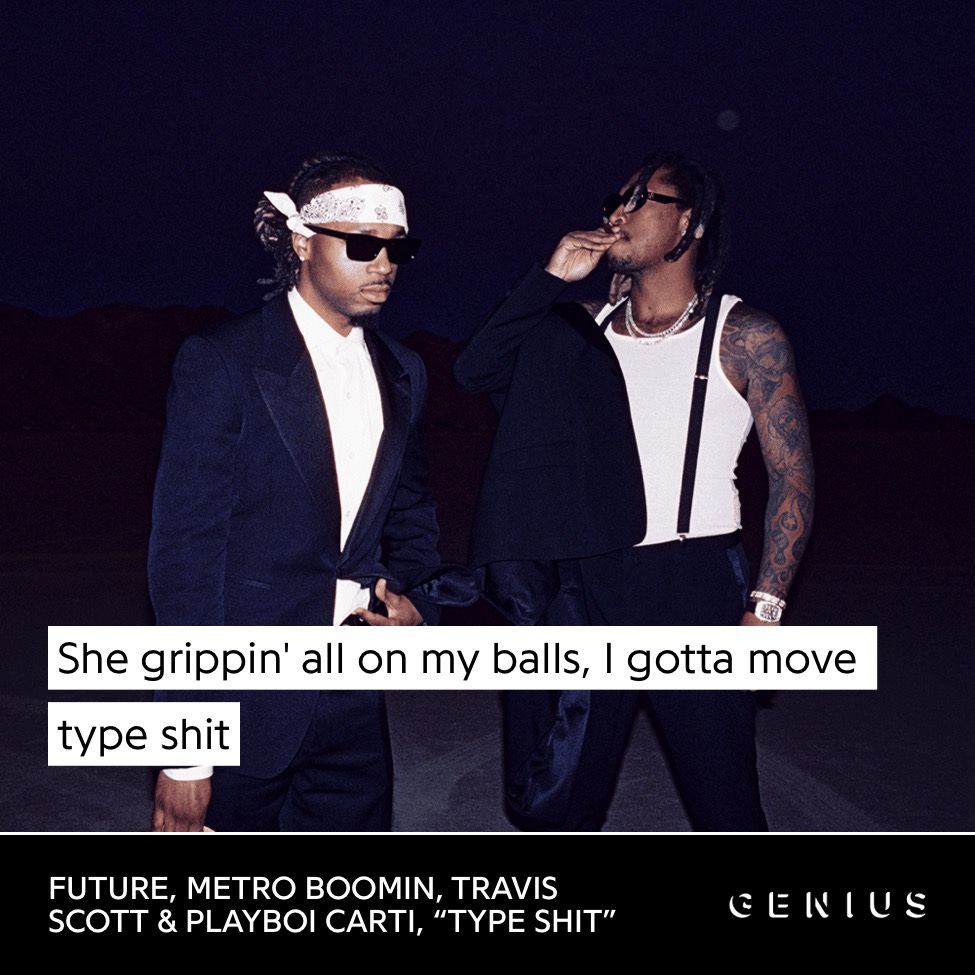
Type Shit, the fourth track on Future and Metro Boomin’s album titled We Don’t Trust You, is a triumph of form, function, and future-forward misogyny. A bombastic collaboration filled with irreverent ad-libs about Percocet, whores, and various modes of flexing, it manages to reaffirm its own thematic coherence through the hypnotic repetition of the titular phrase: “type shit.” Like a chorus in a Greek tragedy or a dissertation footnote, it punctuates every bar with finality; a linguistic stamp of authenticity in a world increasingly devoid of meaning.
But buried deep in this nihilistic anthem is a verse so raw, so startling in its emotional intelligence, that it demands closer analysis. Playboi Carti, a rapper best known for mumbling incoherently at the end of various rapper’s songs and dressing like an inner city vampire, steps briefly out of his trademark gibberish and into clarity. And in this moment of lucidity, he delivers what may be the most important lyric of 2024:
“She gripping all on my balls, I gotta move, type shit.”
This single bar deserves serious cultural analysis. In the line “she gripping all on my balls I gotta move type shit,” Playboi Carti confronts the unspoken yet pervasive gendered dynamics of bodily autonomy and male discomfort in heteronormative sexual interactions. While mainstream discourse often centers women as recipients of unwanted attention, Carti bravely reverses the narrative, exposing how men, too, are subject to non-consensual touch, a topic rarely addressed in hypermasculine rap culture especially in a post #MeToo world. His use of the phrase “gotta move” functions not merely as a physical response, but as a symbolic departure from oppressive expectations that men must welcome all sexual advances. By placing this moment within the casual flow of a club-ready track, Carti subversively critiques the societal silence around male vulnerability. In this essay, I will explore how this lyric offers a groundbreaking lens on performative masculinity, bodily agency, and the nuanced politics of consent in late capitalist hookup culture.
While the lyric in question may initially seem antithetical to the sprawling introspective monologues of Fyodor Dostoevsky, a closer reading reveals eerie symmetry between Playboi Carti’s spontaneous decision to physically “move” and the psychological inertia of Dostoevsky’s narrator in Notes from Underground. Both men are caught in the throes of unwanted intimacy (think Carti’s literal, the Underground Man’s emotional) and both respond with an act of retreat. In Notes, the narrator famously declares, “I am a sick man… I am a spiteful man,” distancing himself from society, romance, and touch. Likewise, Carti removes himself from unsolicited fondling with the weary decisiveness of a man who has seen too much. He too is sick: of this world, of these hoes, of this pressure to be perpetually accessible.
The Underground Man’s entire identity is defined by his refusal to act as others expect, a condition that culminates in painful self-isolation. His rejection of society’s norms, much like Carti’s refusal to engage in a presumably pleasurable sexual encounter, becomes an act of rebellion — one rooted not in strength, but in deep alienation. When Carti says “I gotta move,” we should not mistake this for a flex. It is an expression of agency hard-won through paranoia, boundary-setting, and perhaps trauma. He is not enjoying the moment; he is surviving it. It is a modern retelling of the existential standoff between body and will, desire and dignity. Like Dostoevsky’s narrator, Carti positions himself as a man both disgusted by the world and enslaved to it. He is a man who says “no” not out of clarity, but out of a deep and unspoken ache.
Ultimately, the tension between erotic expectation and emotional detachment drives both men toward dramatic, isolating gestures. For Dostoevsky’s anti-hero, it’s a descent into irrelevance and madness. For Carti, it’s a moonwalk out of the club with his dignity intact. One uses high-minded, sprawling prose to obscure his vulnerability; the other uses monosyllables and vibey ad-libs. But both are screaming the same thing: “Do not touch me. I am more idea than man.” That Carti chooses to whisper this through the language of contemporary trap music rather than Russian literature is irrelevant. The message remains unchanged: intimacy, when wielded without consent, is violence. And sometimes, the only protest left is movement.
There exists, within the quiet suffering of modern man, an unspoken rite of passage: the brutal, poorly executed handjob. For decades, men have endured this trial in silence, their faces locked in grimaces of performative pleasure as their genitals are gripped like a pepper grinder. We do not cry out, not because it feels good, but because we are afraid. Afraid of bruising egos. Afraid of being “mean.” Afraid that somewhere along the line, a kind-hearted woman has mistaken our dicks for sentient lawn mowers that can be yanked into climax by sheer force. These are not intimate moments, they are acts of psychological warfare disguised as foreplay. Carti’s line, “she gripping all on my balls, I gotta move,” is not just a complaint. It is a declaration. A battle cry. A “me too” for the painfully tugged.
In that moment, Carti becomes more than a rapper. He becomes a prophet for the neglected. A beacon for the men who have ever stared at the ceiling in stunned silence as their testicles were manhandled with the same sensitivity one might use to knead frozen dough. We are told we are lucky to be touched at all. That we should be grateful. And so we suffer. Not out of enjoyment, but out of politeness. Carti says: no more. He moves. He chooses self-preservation over misplaced courtesy. His bravery, in that single bar, shines like a lighthouse through the fog of sexual discomfort, guiding us toward a future where men can say, clearly and without shame: “Please stop, you are tugging my penis like a you are trying to yank a better looking guy out of me.”
In summation, Type Shit is more than a trap anthem… it is a cultural text, a postmodern cry for agency in the erogenous battlefield. Where Dostoevsky’s Raskolnikov crushed an old woman to wrest control over his moral universe, Playboi Carti simply moves his balls out of a vice grip. And yet, the courage required is no less. In an era where masculinity is often filtered through silence or satire, Carti dares to confront discomfort head-on, or… rather, hand-on. His verse is a revelation, a call to action, and a soft-spoken revolution against one of the last unchallenged frontiers of male pain. We owe him gratitude. And perhaps, a gentle reminder to all: if you love someone, hold them… but not like that.
 | A guest post by
|
People (me) are calling this the greatest post ever
This is a phenomenal piece for a multitude of reasons. One on hand, it's obviously satire about the ridiculous of Future, his music, and mediocre Hip Hop that shifted due to mumble rap.
At the same time, it addresses how Black women are often expected to see unwanted sexual advances as complimentary, a sign of true Black womanhood. Because only real Black women would understand that being a REAL woman requires them to want to submit to anything and everything men desire.
But then there's another topic altogether that isn't usually addressed, but must be addressed with nuance: abuse against Black men and how toxic masculinity prevents men from confronting sexual trauma. Though Black women are more likely to be subjected to sexual violence (often before the the age of 18), Black boys and men also struggle through sexual violence. There are stories about Black boys being molested by adult men and women in their families, by others associated with their family. There are stories about Black boys being sexually abused by female babysitters. But in most cases, these boys grow up as men and retell these stories as rights of passage.
It's because patriarchy has taught Black men that any grown woman who sexualizes them is a prerequisite to true Black manhood. If violated by a man, then it's indication that they were weak and possibly enjoyed it somehow because they didn't "try too hard to fight back." The discourse around sexuality and its erroneous association with childhood molestation will forever bother me, but I digress.
Unfortunately, most Black male survivors of CSA feel pressured to perform toxic masculinity to cover up the fact that there was no one in their lives to help them navigate the crime that took place. Or protect them from the person or people that violated them. And in most cases, these same men end up passing on that same trauma onto their male children. Or end being extremely violent towards Black women and girls (trans and cis) because only way they express their pain is through violence.